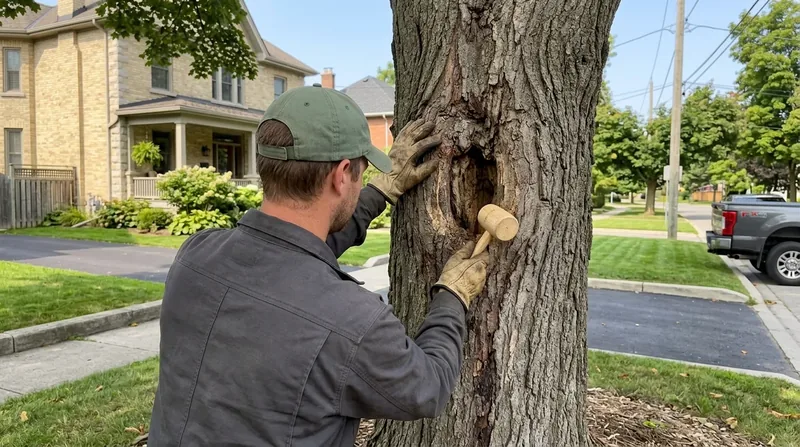




An arborist report and risk assessment in Hamilton is a detailed, written evaluation of a tree's structural condition, health status and potential hazard to property or people. Our ISA Certified Arborists document findings with photographs, measurements and professional recommendations, creating a document that supports insurance claims, property sales, permit applications and neighbour disputes. Mature trees across Hamilton neighbourhoods, silver maples on ravine lots, oaks in Westdale, Norway spruce in post-war subdivisions, often require this assessment before work proceeds. Whether you are facing a City of Hamilton permit requirement, resolving a liability question or planning a major removal, we deliver a report that protects your interests and guides your next step.
Why an arborist report protects your property
A professional assessment identifies hazards that are invisible to the untrained eye. Dead limbs, internal decay, root damage from construction or soil compaction, and structural imbalance can trigger failure without warning, especially after ice storms or windstorms common in the Hamilton area. Insurance companies demand evidence of risk before they will pay claims; municipalities require supporting documentation for removal permits; property buyers need assurance that large trees will not fail in the first five years of ownership. Our report becomes your proof that you acted responsibly and that any incident was not foreseeable neglect.
- We photograph the entire crown, trunk, root collar and surrounding hazards.
- We measure height, diameter at breast height (DBH) and distance to structures.
- We assess foliage density, branch angles, bark condition and signs of disease or pest damage.
- We document any previous pruning, cabling or damage from weather events.
- We assign a risk rating and recommend action (monitor, prune, cable, remove or treat).
- We deliver a signed, stamped report suitable for insurance, legal and municipal use.
This documentation is what separates a casual inspection from professional liability protection.
Real example: A 60-year-old sugar maple on a ravine lot in Ainslie Wood was showing crown dieback and bark splitting. The homeowner obtained our arborist report, which identified internal decay and recommended removal before a spring windstorm could drop a limb onto the neighbour's roof. The report supported a City of Hamilton permit application and was accepted by the insurance adjuster as proof of timely action. Cost of the report:$275. Avoided claim denial:$12,000+.
How we conduct your risk assessment in the Hamilton area
Our process is systematic and thorough. We visit your property, examine the tree from ground level and at height if necessary, and interview you about the tree's history, recent weather damage and your concerns. We use a climbing rope and harness to inspect branches and crown condition up close, and we test wood firmness with a resistograph or sonic tomography if decay is suspected. We then compile photographs, measurements, findings and recommendations into a report that is clear to homeowners but rigorous enough for municipal review boards and insurance adjusters.
- We schedule the visit at your convenience, typically within 3 to 5 business days.
- We spend 45 to 90 minutes on site, depending on tree size and access.
- We take overhead and ground-level photographs, measure critical dimensions and note environmental context.
- We climb or use a bucket lift to inspect the crown and upper trunk up close.
- We test wood condition with hand tools and acoustic instruments if decay is evident.
- We compile our findings into a formal report, stamped and signed by an ISA Certified Arborist.
- We deliver the report by email within 5 to 7 business days and remain available to answer questions.
The result is a professional document that you can submit to your municipality, insurer or legal counsel with confidence.
Example timeline: You call us on a Monday morning. We schedule a visit for Thursday afternoon. Our arborist spends 75 minutes examining a 50-year-old red oak in Kirkendall, taking 15 photographs and running a decay test. By the following Wednesday, you receive a 4-page report with colour images, risk assessment and three options (monitor, prune or remove). You forward it to the City of Hamilton planning department on Friday. Your permit is approved the following week.
Report methods and assessment tools
| Assessment Method | What It Detects | When We Use It |
|---|---|---|
| Visual inspection and climbing | Crown structure, branch angles, foliage density, bark damage, previous pruning scars, insect galleries and cavities visible to the eye. | Every assessment; the foundation of the report. |
| Resistograph or sonic tomography | Internal decay, hollow sections and wood density changes inside the trunk or major limbs without cutting. | When bark is intact but we suspect internal rot, or when a tree has cavities, cankers or history of storm damage. |
| Root collar excavation | Root flare health, girdling roots, soil compaction, and signs of root disease (common after construction on Hamilton ravine lots). | When risk centres on the base of the tree or when soil has been disturbed. |
| Measurement and photography | Height, diameter at breast height (DBH), distance to structures, overhead clearances and proximity to utilities. | Every report; essential for permit applications and insurance documentation. |
| Pest and disease identification | Signs of emerald ash borer, scale insects, anthracnose, oak wilt, ash dieback and other in Hamilton and the surrounding area threats. | When we observe discoloration, defoliation, cankers, galleries or other diagnostic symptoms. |
Each method is non-invasive and leaves the tree unharmed. We combine findings into a single risk matrix that rates the likelihood of failure and the consequence if failure occurs, helping you and the City of Hamilton understand whether the tree should remain, be monitored, be pruned or be removed.
Municipal permits and regulatory context
The City of Hamilton may require a permit for a private tree removal, and an arborist report supports that application by documenting the hazard and justifying the action. Rules and thresholds differ from one municipality to the next across the Hamilton area, so we always advise you to contact your local planning or forestry department before work begins. Our report is written to meet municipal standards and includes all information a review board needs to approve your permit quickly. We respect approach distances near your private electrical service entrance and never touch the public distribution network operated by your local utility or Hydro One. When trees are near hydro lines, we assess clearance carefully and recommend the safest removal method. If your property is in Burlington, Oakville, Milton, Grimsby or another surrounding municipality, we follow that jurisdiction's rules as well. Our report is your first step toward compliance and peace of mind.
For tree removal in Hamilton or other services, we work closely with your permit application. If you need an assessment of a diseased ash tree, see our ash tree removal and emerald ash borer assessment page. For trees showing storm damage or structural concerns, we also offer tree cabling and bracing as an alternative to removal if the tree has value and can be stabilized. Questions about cost or timing? Contact us at (289) 796-3100 or visit our contact page for a free estimate.
Prices Arborist Report & Risk Assessment in Hamilton — Indicative pricing
| Service | Price | Details |
|---|---|---|
| Single tree assessment | From $195 | Complete visual inspection, photographs, measurements and risk rating for one tree |
| Multi-tree property assessment | From $395 | Assessment of 3 to 5 trees on the same property, combined into one report |
| Decay testing (resistograph or sonic tomography) | Add $75 to $125 | Internal wood analysis if decay is suspected; included with complex assessments |
| Insurance or legal report | From $275 | Formal, stamped arborist report suitable for insurance claims, property sales or municipal permits |
| Travel time | Included | No charge for travel within Hamilton and the surrounding area |
| Free estimate and consultation | Complimentary | Call (289) 796-3100 to discuss your tree and receive a preliminary quote within 24 hours |
Indicative prices; free, personalized estimate within 24h at (289) 796-3100.