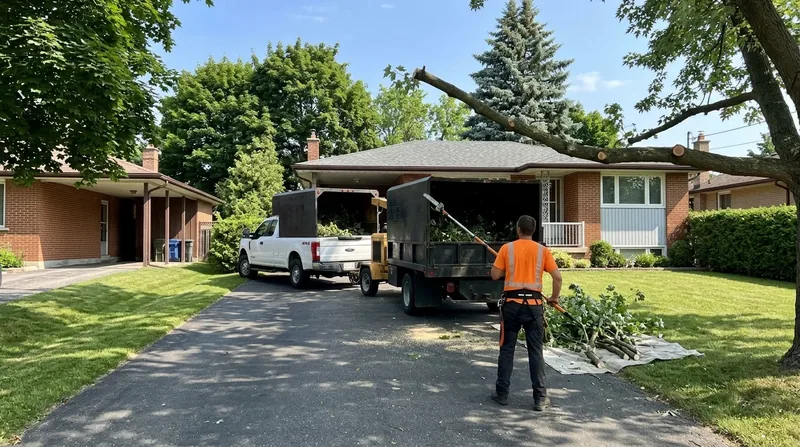




Low branch removal in Hamilton keeps your driveway, roof and service entrance clear while protecting tree health. Mature maples, oaks and spruces throughout the Hamilton area often develop low limbs that interfere with vehicles, block gutters or hang over electrical service drops. Our ISA Certified Arborists make precise cuts at the branch collar so the wound closes properly, avoiding the stub cuts that invite disease. We have been removing hazardous low branches since 2013, working safely on ravine lots, tight backyards and properties with limited access. Call us at (289) 796-3100 for a free estimate, or read more about our tree trimming services.
Why low branch removal matters in the Hamilton area
Low limbs create real hazards. A branch hanging 2 metres over your driveway will eventually catch a vehicle roof or rearview mirror. Limbs touching your roof trap moisture, accelerate shingle wear and provide a bridge for squirrels and raccoons to reach your soffit. Even more critical, branches growing near your private electrical service entrance (the wire running from the pole to your house) can arc to live conductors during ice storms or high winds, creating a fire or electrocution risk. We respect minimum approach distances and never touch the public distribution network operated by your local utility or Hydro One.
- Remove limbs blocking sightlines at driveways and parking pads
- Clear branches touching roofs, gutters or soffits to prevent water damage
- Eliminate low growth near electrical service entrances for safety
- Thin branches that trap snow and ice in winter conditions
- Open sight lines for pedestrians and property security
Each cut stops the branch from growing back into the same space, and proper technique means the tree heals without leaving a permanent wound.
Local example: A typical low branch removal over a driveway in Hamilton costs from $95 to $350 depending on branch diameter, height and access. A job involving multiple limbs near a service entrance may run $400 to $750. We provide a free estimate on site so you know the exact price before we start.
How we remove low branches safely
Low branch removal looks simple but demands precision. A careless cut leaves a stub that rots, or a flush cut that wounds the collar. We use a three-step method: first, we undercut the branch 30 centimetres from the trunk to prevent the bark from tearing as the limb falls. Second, we make the top cut just beyond the undercut, removing most of the weight. Finally, we cut at the branch collar (the swollen ring where the branch meets the trunk), leaving the collar intact so the tree compartmentalises the wound and heals on its own. On larger branches or those near power lines, we use rope and pulley systems to lower the wood safely rather than letting it drop.
- Assess the branch diameter, angle and proximity to structures or wires
- Position equipment and crew to maintain a safe work zone
- Make the three-cut sequence to prevent bark damage
- Lower branches with rope systems if needed to protect property
- Chip small branches on site or remove larger wood for disposal
- Clean up all debris and leave your yard ready to use
The entire job typically takes 30 minutes to 2 hours depending on how many limbs we are removing and how accessible they are. Learn more about our tree pruning and crown reduction service if you need a more comprehensive structural trim.
Real scenario: A homeowner in Westdale had a silver maple with a 20 centimetre limb hanging 1.8 metres over the driveway. Our crew undercut, removed the limb in three cuts, and chipped the small branches on site in 45 minutes for $185. The homeowner now parks safely and the tree has a clean wound that will close within two seasons.
Methods and tools for branch removal
| Method | Description | Best for |
|---|---|---|
| Hand saw and pruning tools | Manual cutting for branches under 10 centimetres diameter | Tight spaces, low noise, minimal disruption |
| Pole saw or pole pruner | Gas or electric saw on an extension pole, reaching limbs 5 to 8 metres high | Overhead branches without climbing, standard residential jobs |
| Climbing with hand saw | Arborist climbs into the canopy using rope and harness for precise cuts | Large branches, complex geometry, branches over structures or wires |
| Rope and pulley lowering | Heavy limbs controlled with rigging to lower safely to the ground | Branches near houses, vehicles, service lines or fences |
The choice of method depends on branch size, tree height, site access and proximity to hazards. We always prioritise safety and the health of the tree.
When to trim low branches in the Hamilton area
Timing affects both tree health and job safety. Trimming and structural pruning are best done in dormancy, from late fall to late winter, when the tree is not actively growing and wound closure is slower but cleaner. Winter work also means fewer insects and disease spores in the air. However, if a low branch poses an immediate safety risk (hanging over a driveway, touching power lines, or damaged by storm), we remove it year-round. Our 24/7 emergency tree removal service responds to ice storm and windstorm damage, which peak in late fall and summer. If the branch is merely a nuisance, plan the work for January through March when we have the most availability and the tree will heal most efficiently.
Permits and regulations for low branch removal
Low branch removal on your own property is generally not regulated, but context matters. The City of Hamilton may require a permit for a private tree removal depending on species, size and location. Low branch removal (as opposed to full tree removal) rarely triggers a permit requirement, but if your job involves removing a large limb from a protected species or a heritage tree, the City may ask for documentation. We can help you understand whether a permit applies and, if needed, we provide an arborist report and risk assessment to support your application. Rules vary across the Hamilton area and surrounding municipalities, so we always check local requirements before starting work. When your service entrance is involved, we respect the minimum approach distance and never work on the public utility network.
Why hire a certified arborist for low branch removal
A quick cut with a chainsaw is not the same as proper branch removal. Certified arborists understand tree anatomy and wound closure. We know the difference between a branch collar cut (which heals) and a flush cut or stub (which invites rot and disease). We also carry full liability insurance and work safely around power lines, roofs and vehicles. Our ISA Certified Arborists have been trained to recognise disease, pest damage and structural defects, so we can flag problems you might miss. When you call us at (289) 796-3100, you get a professional assessment, a transparent free estimate and work that protects your tree and property. Visit our contact page to schedule your free estimate today.
Prices Low Branch Removal in Hamilton — Indicative pricing
| Service | Price | Details |
|---|---|---|
| Single low branch removal | From $95 | One branch under 10 cm diameter, simple access |
| Multiple branches, same tree | From $185 | Two to four limbs, standard height and access |
| Branch near service entrance or roof | From $275 | Safety setup, rope lowering, proximity to structures |
| Large branch or complex job | From $400 | Branch over 15 cm diameter, climbing required, rigging setup |
| Free estimate | Complimentary | On-site assessment, written quote, no obligation. Call (289) 796-3100 |
Indicative prices; free, personalized estimate within 24h at (289) 796-3100.