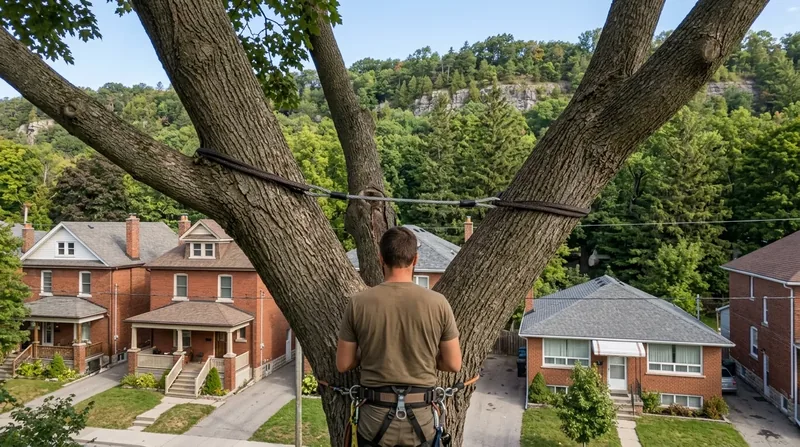




Tree cabling and bracing in Hamilton keeps mature trees standing when they develop weak branch unions or cracked scaffold limbs. Rather than remove a 40-year-old maple or oak, flexible cabling systems allow the tree to heal and remain in your landscape. Escarpment Tree Trimming has installed hundreds of cable and brace systems across Hamilton and the surrounding municipalities since 2013. Our ISA Certified Arborists assess each tree individually, design the right support strategy, and execute the work safely. If a large specimen on your property shows signs of structural failure or splits during a windstorm, cabling often saves it from the stump grinder.
Why tree cabling and bracing matters in Hamilton
Hamilton's mature residential neighbourhoods are filled with trees older than the houses below them. Silver maple, sugar maple, red oak and birch commonly develop codominant stems or weak crotches where two main limbs meet at a tight angle. Ice storms, heavy snow, and summer windstorms put extra load on these weak points. A single split or failure can compromise the entire tree's stability and safety. Cabling and bracing address this risk without felling the tree, preserving shade, privacy and property value.
- We install flexible steel cables between major limbs to distribute weight and reduce movement during wind or ice load.
- We use rigid braces or rods to support cracked limbs or codominant stems that cannot heal on their own.
- We position hardware high in the crown to remain invisible from the ground while the tree compartmentalizes damage and grows around the support.
- We follow ISA standards for cable spacing, hardware placement and tension so the tree remains healthy and the system lasts 10 to 15 years.
- We document the work with photographs and a written report for your insurance claim or municipal permit application if required.
The result is a structurally sound tree that can live another 20, 30 or 40 years with proper ongoing pruning and inspection.
Real example: A 60-year-old sugar maple in Kirkendall developed a deep radial crack where two main limbs joined. Removal would have cost $2,500 and opened a 15-metre gap in the canopy. Instead, we installed a three-cable system with one rigid brace, total investment $950. The tree remains healthy and the homeowner kept the shade and privacy.
How we design and install cabling systems
Every tree is different. We do not apply a standard formula. Our ISA Certified Arborist visits your property, climbs the tree if necessary, assesses the crack or weak union, and determines whether cabling alone, bracing alone, or a combination will work best. We measure limb diameter, angle of attachment, crown balance and overall tree health. We then propose a system tailored to that specific tree and budget.
- We conduct a free visual inspection on site, identify the weak points and explain the options in plain language.
- We prepare a written estimate that lists the number of cables or braces, the hardware grade, and the expected longevity.
- We schedule the work during dormancy (late fall to late winter) when the tree is least stressed and we have clear sight lines into the crown.
- We use a certified climber to position hardware at the correct height and angle, usually 60 to 80 per cent of the distance from the base to the crown top.
- We tension cables to allow 2 to 3 centimetres of movement so the tree can flex in wind without strain on the hardware.
- We clean up all debris, remove any dead wood we encounter, and leave the site ready for use the same day.
Once installed, a cable or brace system requires inspection every two to three years. We offer annual checkups in the Hamilton area to ensure hardware remains tight, cables show no signs of rust, and the tree continues to compartmentalize any original damage.
Cost reality: A basic two-cable system on a tree 20 to 30 metres tall typically costs $800 to $1,200. A complex installation with four cables, rigid braces and multiple weak points may reach $2,000 to $3,000. Emergency repairs to a tree that has already split during a storm often cost more because damage assessment and remedial pruning are more extensive. Contact us for a free estimate.
Cabling methods and hardware options
| Method | Description | Best for |
|---|---|---|
| Flexible steel cable (3/8 inch) | Galvanized or stainless cable anchored with hardware at two or more points in the crown. Allows controlled movement and distributes load across limbs. | Codominant stems, weak crotches, mature trees with good overall structure. |
| Rigid brace or rod system | A single rigid rod connects two limbs or supports a cracked scaffold. Restricts movement almost entirely and transfers load directly through the rod. | Trees with existing cracks, split limbs, or limbs that cannot tolerate any movement. |
| Combination system (cable and brace) | Multiple cables in the upper crown combined with one or two rigid braces in the lower or middle crown. Provides both flexibility and direct support. | Complex trees with multiple weak points or trees that have already sustained storm damage. |
| Lightning protection (optional) | A grounded copper cable runs from the crown to the soil, reducing lightning strike risk. Often combined with cabling or bracing. | Tall trees in exposed locations or those with a history of lightning damage. |
We stock ISA-approved hardware in stainless steel and galvanized finishes. Stainless hardware costs more but lasts longer in in Hamilton and the surrounding area's freeze-thaw cycles and acid rain. We always use hardware rated for the limb diameter and expected load, never undersized fasteners or amateur rope systems.
Permits and municipal requirements
The City of Hamilton may require a permit for a private tree removal, and an arborist report and risk assessment supports that application. Cabling and bracing are not a removal, so they rarely trigger a permit requirement on their own. However, if your tree is protected by a municipal bylaw or sits on a ravine lot, we recommend confirming with the City before work begins. We can provide a written report documenting the tree's condition, the structural risk and the cabling solution, which you can attach to any municipal inquiry.
If your tree stands near your private electrical service entrance (the wire from the pole to your house), we maintain safe approach distances as required by your local utility and Hydro One. We never work on the public distribution network. If the tree interferes with hydro lines, we coordinate with the utility or recommend professional line clearance as a separate step.
On ravine lots common across the Hamilton area, access is often steep and narrow. We bring smaller equipment and use hand tools where necessary. We remove all debris and leave the site as we found it, respecting property lines and erosion control.
When to cable and brace your tree
Timing matters. Cabling is most effective when the tree is dormant (late fall to late winter). The tree is not actively growing, so we avoid wounding active cambium. Branch movement is minimal, allowing us to tension cables precisely. We also have better visibility into the crown without leaves. If your tree has already cracked or split during a storm, we respond immediately to assess whether emergency pruning is needed before we install support hardware.
Once cabled, a tree requires annual or biennial inspection. We climb the tree, check cable tension, look for signs of rust or damage to hardware, and verify that the tree is healing around the support. If the original crack has compartmentalized well and the limbs have grown stronger, we may eventually remove the cable or brace. If the tree continues to show weakness, we keep the system in place indefinitely.
For questions about whether your tree is a candidate for cabling, call us at (289) 796-3100 or request a free estimate. We serve Hamilton, Burlington, Oakville, Milton, Grimsby, West Lincoln, Pelham and Haldimand County.
Prices Tree Cabling & Bracing in Hamilton — Indicative pricing
| Service | Price | Details |
|---|---|---|
| Basic cable system (2 cables, single weak point) | From $800 | Trees 15 to 25 metres tall with one codominant stem or weak crotch |
| Multi-cable system (3 to 4 cables, multiple weak points) | From $1,500 | Larger trees or those with complex crown structures requiring distributed support |
| Rigid brace or combination system (cable and brace) | From $1,200 | Trees with existing cracks, split limbs, or severe structural damage |
| Emergency assessment and repair (storm damage) | On quote | Same-day or next-day evaluation and remedial pruning included |
| Annual inspection and cable maintenance | From $200 | Tension check, hardware inspection and minor adjustments |
| Free estimate and site visit | Complimentary | Response within 24 hours at (289) 796-3100 |
Indicative prices; free, personalized estimate within 24h at (289) 796-3100.