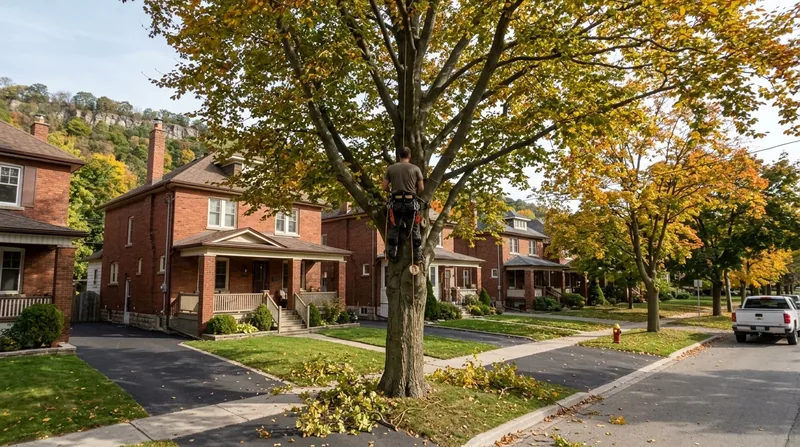




Tree pruning and crown reduction in Hamilton keeps mature maples, oaks and beeches healthy, safe and visually balanced without removing the tree. The Hamilton area's steep ravine lots, mature street trees in post-war subdivisions and tightly spaced backyards mean that structural pruning must be precise, safe and respectful of neighbouring properties. Our ISA Certified Arborists work year-round to thin canopies, reduce wind load and rebalance frameworks damaged by ice storms or heavy snow. We do not carve artificial shapes into trees; we work with their natural form.
Why structural pruning and crown reduction matter
A mature tree in Hamilton often grows under stress: ice storms bend limbs, uneven light creates lopsided crowns, and close neighbours constrain growth. Structural pruning removes dead and crossing branches, thins dense canopies to reduce wind resistance and rebalances the framework so the tree does not fail. Crown reduction lowers the height or spread of a large tree without topping it, preserving its natural form and vigour. Without this work, trees become hazardous and decline.
- We remove dead, diseased and crossing branches to improve tree health and appearance.
- We thin the canopy to reduce wind sail and allow light to reach the ground and neighbouring trees.
- We reduce crown size and weight to lower risk of failure in storms and ice events.
- We rebalance asymmetrical frameworks so the tree stands stable and looks natural.
- We work around hydro lines and property lines, respecting approach distances and your neighbours' sight lines.
Proper pruning extends tree life by decades and prevents costly removals later. A tree pruned well in its 40s or 50s often survives to 100 or beyond.
Local insight: A 15-metre sugar maple in Westdale that is crowded by neighbours and leaning toward a roof can lose 2 to 3 metres of height and 30 percent of crown volume through careful reduction. The tree recovers within two seasons and stands safely for another 30 years. Removal would cost $2,500 to $4,500 and destroy decades of shade and wildlife habitat.
How we prune and reduce crown in the Hamilton area
Our process begins with a climb and visual inspection. We assess branch structure, identify dead wood, measure clearances to hydro lines and buildings, and discuss your goals. We then work methodically from the ground up, making clean cuts at branch collars and removing material safely to a chipping truck or wood pile. Crown reduction follows ISA standards: we never top a tree or leave stubs. Every cut has a reason.
- We climb or use a lift to reach the full crown and inspect every major branch.
- We identify and remove all dead, diseased, crossing and rubbing branches first.
- We thin the canopy by removing smaller interior branches to improve light penetration and air flow.
- We reduce crown height or spread gradually, making proportional cuts that preserve the tree's natural silhouette.
- We lower all material safely using ropes and ground crew, then chip or stack it for your use.
- We clean the site thoroughly and haul away all debris unless you wish to keep wood for firewood or chipping.
Dormancy (late fall to late winter) is the best season for structural pruning. The tree is not pushing new growth, wounds seal faster and we can see the full branch structure. Spring and summer pruning is possible for safety reasons but should be limited. Learn more about our general tree trimming service for routine maintenance.
Real example: A red oak in Milton with a split main fork and heavy lean toward the driveway required reduction of the lower limb by 4 metres and thinning of the upper crown. The work took one day, cost $1,850 and eliminated the risk of limb failure. Two years later the tree is thriving and the driveway is safe.
Pruning methods and techniques
| Method | Description | When to use |
|---|---|---|
| Crown thinning | Selective removal of smaller branches throughout the canopy to reduce density and improve light penetration. | Mature oaks, maples and beeches that are overly dense or shading gardens and neighbouring properties. |
| Crown reduction | Shortening of major limbs by 15 to 30 percent to lower the overall height or spread of the canopy. | Trees that are too tall for their site, leaning toward structures or at risk of wind or ice failure. |
| Structural pruning | Removal of dead, diseased, crossing and rubbing branches; correction of weak branch angles and co-dominant stems. | Young to mature trees that require framework correction or recovery from storm damage. |
| Clearance pruning | Removal of lower branches to clear sight lines, allow vehicles or pedestrians to pass, or maintain distance from buildings and hydro lines. | Street trees, trees near driveways or power lines, and trees overhanging roofs or fences. |
Safety, permits and site conditions in Hamilton neighbourhoods
Pruning work is inherently hazardous. We are fully insured and carry liability coverage for property damage and personal injury. Our crews use fall protection, rigging equipment and spotters to prevent accidents. We respect hydro lines: we maintain safe approach distances from your private service entrance and never work on the public distribution network operated by your local utility or Hydro One. Work near hydro lines is done only after confirming clearances and notifying the utility if required.
The City of Hamilton may require a permit for certain tree work on private property, depending on tree species, size and location. We advise you of any permit requirement and can prepare an arborist report to support your application. Rules vary across the surrounding municipalities, so we confirm local requirements before starting work. Disposal of pruning debris is included in our service: we chip material on site or haul it away, leaving your property clean.
Access is often tight in Hamilton backyards. Ravine lots and narrow gates mean we may need to carry equipment by hand or use smaller rigging. We assess access during the free estimate and plan the job accordingly. Request a free estimate and we will visit your property to measure, discuss your goals and provide a firm price with no hidden costs.
When to prune in the Hamilton area
Timing matters. Dormant season pruning (late fall to late winter) is ideal for structural work because the tree is not actively growing, wounds seal efficiently and we can see the full branch structure without foliage. Spring and summer pruning is acceptable for hazard reduction or dead wood removal but should be limited to avoid stress. Never prune during active growth in late spring and early summer unless there is an immediate safety risk. Avoid pruning in late summer and early autumn when trees are preparing for dormancy.
Ice storms and summer windstorms often damage trees and require emergency pruning or removal. We respond 24/7 to hazardous conditions and emergency tree removal across the Hamilton area. Call (289) 796-3100 anytime.
Why choose Escarpment Tree Trimming for crown reduction
We have been serving the Hamilton area since 2013. Our crew includes ISA Certified Arborists who understand local tree species, soil conditions and weather patterns. We prune for health and safety, not aesthetics alone. We respect property lines, work safely around hydro lines and clean up thoroughly. We provide a free estimate with no obligation, and our pricing is transparent. If you have questions about your trees or need advice on timing, call us at (289) 796-3100 or request a free quote online. We serve Hamilton, Burlington, Oakville, Milton, Grimsby, West Lincoln, Pelham and Haldimand County.
Prices Tree Pruning & Crown Reduction in Hamilton — Indicative pricing
| Service | Price | Details |
|---|---|---|
| Crown thinning (small to medium tree) | From $425 | Selective branch removal to improve light and reduce density on trees up to 12 metres tall |
| Crown reduction (medium tree) | From $675 | Height or spread reduction of 15 to 30 percent on mature maples, oaks or beeches |
| Structural pruning and rebalancing | From $550 | Removal of dead, diseased and crossing branches; correction of weak structure |
| Large tree or complex work | By estimate | Trees over 15 metres tall, multiple hazards or tight access require site assessment |
| Travel | Included | No charge for visits within Hamilton and the surrounding municipalities |
| Free estimate | Free | Call (289) 796-3100 or request online; response within 24 hours |
Indicative prices; free, personalized estimate within 24h at (289) 796-3100.