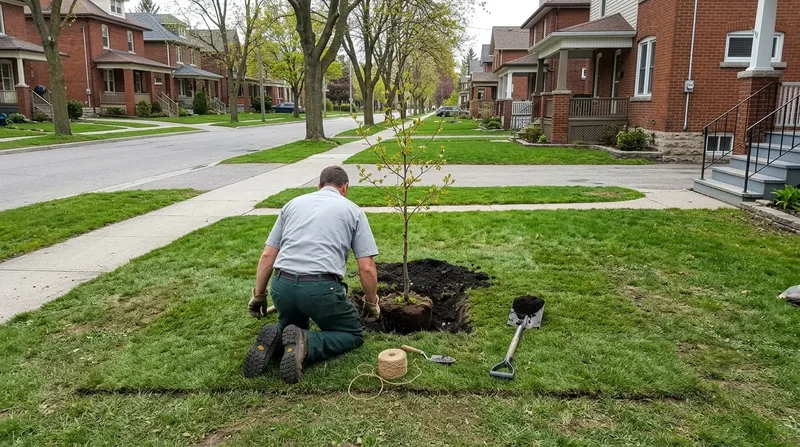




Tree planting in Hamilton requires more than digging a hole and dropping in a sapling. The Carolinian climate of southern in Hamilton and the surrounding area, combined with Hamilton's mix of mature residential neighbourhoods, ravine lots, and tight backyards, demands species selection, proper planting depth, staking where needed, and clear watering instructions for the first critical season. At Escarpment Tree Trimming, we've been establishing trees across Hamilton and the surrounding area since 2013, working with our ISA Certified Arborists to match each planting to your soil, light, and long-term landscape goals. Whether you're filling a gap left by removal, establishing a windbreak on a slope, or creating privacy along a property line, we handle species choice, site preparation, and aftercare so your investment thrives.
Why Tree Planting Matters in Hamilton Neighbourhoods
Hamilton's tree canopy has thinned over decades. Post-war subdivisions in Westdale and Kirkendall have mature street trees now in decline, while newer properties often lack established shade and structure. Planting the right species at the right depth transforms a bare lot into an asset that improves property value, reduces cooling costs, and provides habitat. Poor planting kills trees within two years, wasting money and leaving gaps. We assess your site, choose species suited to your microclimate, and plant with the precision that ensures survival and vigorous growth.
- Select native and adapted species suited to Carolinian southern in Hamilton and the surrounding area conditions.
- Prepare soil and amend where compaction or poor drainage is present.
- Plant at the correct depth, with the root collar at or slightly above grade.
- Stake young trees where wind exposure or soil settlement poses risk.
- Provide detailed watering instructions and mulching guidance for the first season.
- Follow up to monitor establishment and address early stress.
Proper planting is the foundation of tree health. A tree planted too deep will rot at the collar; planted too shallow, it will dry out and fail. We get this right from the start.
Key fact: A mature sugar or silver maple in Hamilton can add $3,000 to $5,000 in property value and reduce summer air conditioning load by 20 to 30 percent. Planting the right species now pays dividends for decades.
How We Plant Trees Across the Hamilton Area
Our planting process begins with a site visit. We evaluate soil type, drainage, sun exposure, wind patterns, and your long-term vision. We then recommend species that thrive in your specific location, whether that's a tight backyard in Ainslie Wood accessible only through a standard gate, a ravine lot with steep slopes, or an open suburban setting in Milton or Burlington. Once species and location are confirmed, we prepare the site, dig the planting hole to exact specifications, amend soil as needed, plant with care, stake if necessary, and provide written aftercare instructions.
- Conduct a detailed site assessment to determine soil conditions, drainage, and light exposure.
- Recommend species suited to your location and long-term landscape design.
- Prepare the planting hole, typically 1.5 times the root ball width and at the correct depth.
- Amend native soil with compost or other material to improve structure and water retention.
- Position the tree with the root collar at or just above the finished grade.
- Backfill and tamp gently to eliminate air pockets without compacting the soil.
- Apply mulch in a ring around the base, keeping it clear of the trunk.
- Install guy wires or stakes if the tree requires support during establishment.
Each step is documented, and we hand over a care sheet tailored to your tree and site. First-season watering is critical, and we make sure you know exactly what to do.
Real example: A customer in Kirkendall wanted to replace a large oak removed due to storm damage. We planted a red oak suited to the site's well-drained soil and full sun, staked it for the first two years, and provided a watering schedule for the dry months of June and July. Three years on, the tree is thriving and already providing significant shade.
Species Selection for Carolinian in Hamilton and the surrounding area
Not every tree thrives in every Hamilton backyard. Sugar and silver maples, red and white oak, birch, and Norway spruce are well-adapted to the region, but site conditions, mature size, and your maintenance tolerance all matter. We also consider disease pressure, such as the emerald ash borer, which has devastated ash populations across in Hamilton and the surrounding area. Our arborists guide you toward species that will live long, grow strong, and suit your property's constraints. Whether you need a fast-growing windbreak, a shade tree for a tight urban lot, or a specimen tree for visual impact, we have recommendations backed by decades of local experience.
| Species | Best For | Notes |
|---|---|---|
| Sugar Maple | Shade, fall colour, property value | Prefers well-drained soil; slow growing but long-lived and iconic in Hamilton neighbourhoods. |
| Red Oak | Large shade, fast establishment | Grows faster than sugar maple; tolerates compacted urban soil; excellent for open yards. |
| White Oak | Long-term investment, wildlife | Slow growing; deep roots; acorns support wildlife; a 100-year commitment. |
| Birch | Ornamental interest, partial shade | Elegant bark and light canopy; prefers moist soil; shorter-lived than oak or maple. |
| Norway Spruce | Windbreak, evergreen screening | Tall, dense, and hardy; widely planted in ravine lots and property lines across Hamilton. |
We source trees from reputable nurseries and verify species and health before delivery. If you're uncertain which species suits your property, our ISA Certified Arborists will walk you through the options during a free consultation.
Planting Permits and Local Regulations in Hamilton
Tree planting itself does not typically require a permit in Hamilton, but if your planting is part of a broader landscape project or if trees are being added to a lot that previously had a removal, it's worth checking with the City. We're familiar with Hamilton's bylaws and can advise whether your project requires any approvals. We also respect setback distances from property lines, ensure planted trees won't interfere with utility lines or services, and position them to avoid future conflicts with neighbours. Our experience across Hamilton, Burlington, Oakville, and the surrounding municipalities means we understand the subtle differences in local rules and apply best practices everywhere we work.
Planting near hydro lines or private electrical service entrances requires safe approach distances. We position trees to mature without risk to infrastructure, and we never plant anything that will grow into overhead lines or underground conduits. If you have questions about what's permitted on your property, contact the City of Hamilton's Parks and Recreation department or ask us during your free site visit. We can also connect you with a certified arborist report if needed for complex or high-value plantings.
First-Season Care and Watering
A newly planted tree is vulnerable. Roots are confined to the planting hole and have not yet extended into surrounding soil. Without consistent moisture, a tree will wilt and die within weeks. We provide detailed written instructions covering watering frequency, depth, and timing for the first growing season. Generally, newly planted trees need deep watering one to three times per week, depending on rainfall and soil type. We also recommend mulching to retain moisture and moderate soil temperature. Avoid over-watering, which can rot roots and invite fungal disease. After the first season, most trees are established enough to rely on natural rainfall, though summer drought may still require supplemental watering in years two and three.
We're available to answer questions as your tree settles in, and we can schedule a follow-up visit to assess establishment and address any concerns. Think of us as your partner in getting your new tree off to the best possible start. For details on our tree planting services and to request a free on-site consultation, contact us at (289) 796-3100 or visit our contact page to request a free estimate.
We also offer complementary services that often go hand in hand with planting. If you're clearing land to make room for new trees, our land clearing service prepares the site. If you're replacing a tree removed due to disease or storm damage, our tree disease diagnosis helps ensure the new planting won't face the same threat. And if you're establishing a hedge or privacy screen, our cedar hedge trimming expertise ensures it stays healthy and shaped. We work across Hamilton, Burlington, Oakville, Milton, Grimsby, and beyond, with crews ready to handle projects of any size.
Prices Tree Planting in Hamilton — Indicative pricing
| Service | Price | Details |
|---|---|---|
| Small tree planting (up to 2 m height) | from $225 | Includes species selection, site preparation, planting, mulching, and care instructions. |
| Medium tree planting (2 to 4 m height) | from $375 | Includes staking and support if needed; soil amendment and aftercare guidance. |
| Large specimen tree planting (over 4 m) | from $550 | Includes heavy soil prep, professional staking, and extended first-season support. |
| Site assessment and species consultation | Included | Free on-site visit to evaluate conditions and recommend species suited to your property. |
| Travel | Included | in Hamilton and the surrounding area (Burlington, Oakville, Milton, Grimsby, West Lincoln, Pelham, Haldimand County) |
| Free estimate | Guaranteed | Response within 24 hours at (289) 796-3100 or via our contact form. |
Indicative prices; free, personalized estimate within 24h at (289) 796-3100.