



Tree disease diagnosis in Hamilton is a critical first step when a tree shows signs of decline, discoloration, pest damage or structural weakness. Our ISA Certified Arborists examine the crown, bark, root collar and visible root plate to determine what can be saved and what must be removed. Hamilton's mature street trees, ravine lots with steep access, and the constant pressure from emerald ash borer, winter ice storms and freeze-thaw cycles mean that early diagnosis often prevents costly removals and protects your property. We have served the Hamilton area since 2013 with on-site assessments that guide your next steps, whether that is treatment, pruning, cabling or removal. Call us at (289) 796-3100 for a free estimate, or visit our arborist report and risk assessment page to learn how a formal written assessment supports permit applications with the City of Hamilton.
Why tree disease diagnosis matters in the Hamilton area
A declining tree is not always obvious at first glance. Canopy thinning, bark damage, root collar erosion and pest entry points develop gradually and are easy to miss until the tree is already in crisis. In Hamilton neighbourhoods, sugar maples and red oaks dominate mature yards and street frontage, while ash trees face relentless pressure from the emerald ash borer. Ravine lots with clay soil and poor drainage compound root stress, and ice storms can fracture branches before you notice crown dieback. Early diagnosis by a certified arborist separates trees worth preserving from those that pose a hazard.
- We assess crown density, branch architecture and signs of disease or pest colonization.
- We examine the root collar and visible root plate for girdling, decay or compaction.
- We identify structural defects such as co-dominant stems, included bark or previous poor pruning.
- We document findings in a written report suitable for municipal permit applications or insurance claims.
- We recommend treatment, pruning, cabling, or removal with clear reasoning.
A clear diagnosis gives you confidence in your next decision and often saves money by preventing emergency removals later.
Local insight: In Ainslie Wood and Kirkendall, we routinely diagnose silver maple decline linked to compacted soil and poor drainage. Early intervention through crown thinning and root collar excavation can extend a tree's life by 10 to 15 years, avoiding the $800 to $1,200 cost of removal.
How we diagnose tree disease on your property
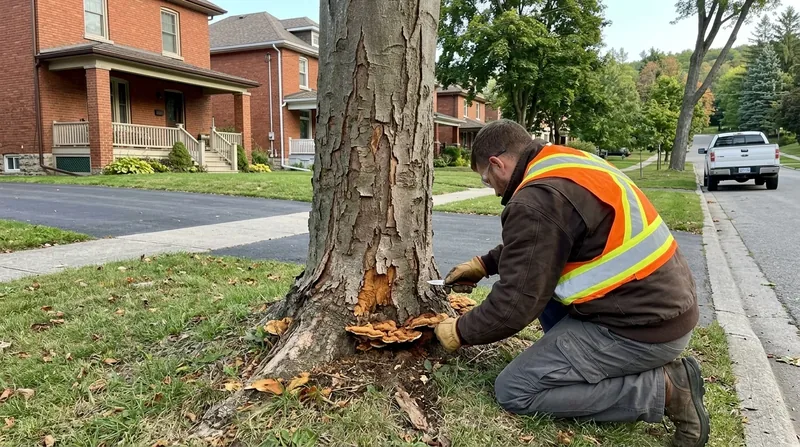
Our process is straightforward and thorough. We arrive with a climbing kit, binoculars, measuring tools and a diagnostic checklist refined over a decade of work in Hamilton. We spend time at ground level, examine the tree from multiple angles, and ask you about its history: when did symptoms start, have there been storms or construction nearby, and how long have you owned the property. This context often reveals the root cause faster than visual inspection alone.
- We inspect the crown from the ground and, if necessary, climb to examine branches and canopy density up close.
- We scrape bark to look for cambium damage, fungal fruiting bodies or pest galleries.
- We probe the root collar with a sonic or resistance drill to assess wood integrity without harming the tree.
- We take photographs and measurements to document the condition and create a baseline for future monitoring.
- We discuss findings on site and answer your questions before leaving.
- We deliver a written report within two business days, including a clear recommendation and estimated cost for any follow-up work.
The entire visit typically takes 30 to 60 minutes depending on tree size and complexity. We never recommend removal unless the tree is genuinely hazardous or beyond recovery.
Real example: A homeowner in Milton noticed yellowing foliage and thinning crown on a 40-year-old white oak. We diagnosed early-stage oak wilt through bark inspection and root collar assessment. Treatment with targeted pruning and soil aeration cost $325, versus the $1,500 removal that would have been necessary six months later.
Diagnosis methods and what they reveal
| Method | What we find | Common in Hamilton |
|---|---|---|
| Visual crown assessment | Canopy density, branch dieback, colour changes, pest nests | Emerald ash borer exit holes, maple anthracnose, oak decline |
| Bark examination | Canker, fungal fruiting bodies, pest galleries, cambium damage | Ash bark beetle under EAB-stressed ash, birch leaf miner damage |
| Root collar and base inspection | Girdling roots, soil compaction, decay, crown raise opportunities | Ravine lot trees with poor drainage, mulch volcanoes, clay-bound roots |
| Sonic or resistance testing | Interior wood decay, hollow sections, structural integrity | Cavity assessment before cabling or removal decisions |
| Climbing inspection | Branch attachment quality, codominant stems, included bark, hidden damage | Ice-storm-fractured branches high in the canopy, previous poor pruning |
Each method feeds into a single diagnosis. We never rely on one indicator alone.
When to request a diagnosis in Westdale and beyond
You do not need to wait for a tree to look sick before calling an arborist. Early diagnosis is most valuable when you notice the first warning signs. Yellowing, sparse canopy, bark damage, sudden branch drop or the appearance of insects or fungal fruiting bodies are all reasons to schedule an assessment. If the City of Hamilton has flagged a tree for removal or you are planning a renovation near a mature tree, a diagnosis and arborist report often provide the evidence needed to challenge a removal order or guide safe construction practices.
- Request diagnosis if canopy thinning or yellowing appears in spring or early summer.
- Contact us after a windstorm or ice event to assess hidden branch damage before it becomes hazardous.
- Schedule diagnosis before major landscaping or construction that could affect root areas.
- Ask for a formal report if you are applying for a permit or disputing a municipal removal notice.
- Bring in a certified arborist if you inherit a property with mature trees and want to understand their condition.
We respond to all requests within 24 hours and can often visit within 3 to 5 business days.
Reports, permits and next steps
Our diagnosis report is not merely an opinion. We document the tree's species, size, health rating, visible defects and our recommendation in a format that meets the City of Hamilton's standards for permit applications. If removal is necessary, the report justifies the decision and helps accelerate approval. If treatment or pruning is recommended, we include estimated costs and timing. Many homeowners use our report to obtain a second opinion from another arborist or to support an insurance claim for storm damage. We can also refer you to our tree removal service or tree cabling and bracing if the diagnosis points to those next steps. For trees showing signs of emerald ash borer, we offer emerald ash borer assessment and treatment as a follow-up.
The City of Hamilton may require a permit for a private tree removal, and the application is normally supported by an arborist report. Rules and thresholds differ from one municipality to the next across the Hamilton area. Our report helps you navigate this process smoothly. We also respect approach distances near private electrical service entrances and never touch the public distribution network operated by your local utility or Hydro One.
To arrange a free estimate or discuss your tree's symptoms, call us at (289) 796-3100 or request a free quote online. We serve Hamilton, Burlington, Oakville, Milton, Grimsby, West Lincoln, Pelham and Haldimand County.
Prices Tree Disease Diagnosis in Hamilton — Indicative pricing
| Service | Price | Details |
|---|---|---|
| Single tree diagnosis and report | From $175 | On-site inspection, written assessment and recommendation |
| Multiple trees (2 to 4 trees) | From $275 | Bundled assessment with separate reports for each tree |
| Property-wide health survey | From $425 | Full evaluation of all mature trees plus landscape risk assessment |
| Formal arborist report for permits or insurance | From $225 | Detailed written assessment suitable for municipal applications |
| Travel | Included | No charge for visits in Hamilton and the surrounding area |
| Free estimate | Free | Call (289) 796-3100 or request online, response within 24 hours |
Indicative prices; free, personalized estimate within 24h at (289) 796-3100.