Understanding Your Mature Maple: Trim or Remove?
A mature maple is often one of the most valuable trees on a Hamilton property. These trees provide shade, aesthetic appeal, and environmental benefits that homeowners understandably want to preserve. However, as maples age, they can develop structural issues, disease, or growth patterns that pose risks to your home, property, or family. Deciding whether your tree needs Tree Trimming or Tree Removal is not always straightforward, and making the wrong choice can be costly or dangerous.
The decision hinges on several factors: the tree's overall health, its proximity to structures, visible damage or disease, and your long-term goals for your landscape. A mature maple that is structurally sound and well-positioned on your lot may thrive with regular maintenance for decades. Conversely, a tree showing signs of decline, significant lean, or major branch failure may be a liability that outweighs the benefits of keeping it. Understanding the difference between these two paths helps you protect both your investment and your safety.
Signs Your Mature Maple Needs Assessment
Before committing to either trimming or removal, you need to know what warning signs to look for. A Tree Pruning & Crown Reduction specialist or certified arborist can evaluate these indicators during a tree assessment. Dead or dying branches, particularly in the upper crown, suggest the tree is under stress and losing vitality. Large cavities or hollow sections in the trunk, bark damage, or signs of pest infestation like emerald ash borer or other wood-boring insects are also red flags. Fungal fruiting bodies (mushrooms growing from the trunk) often indicate internal decay that compromises structural integrity.
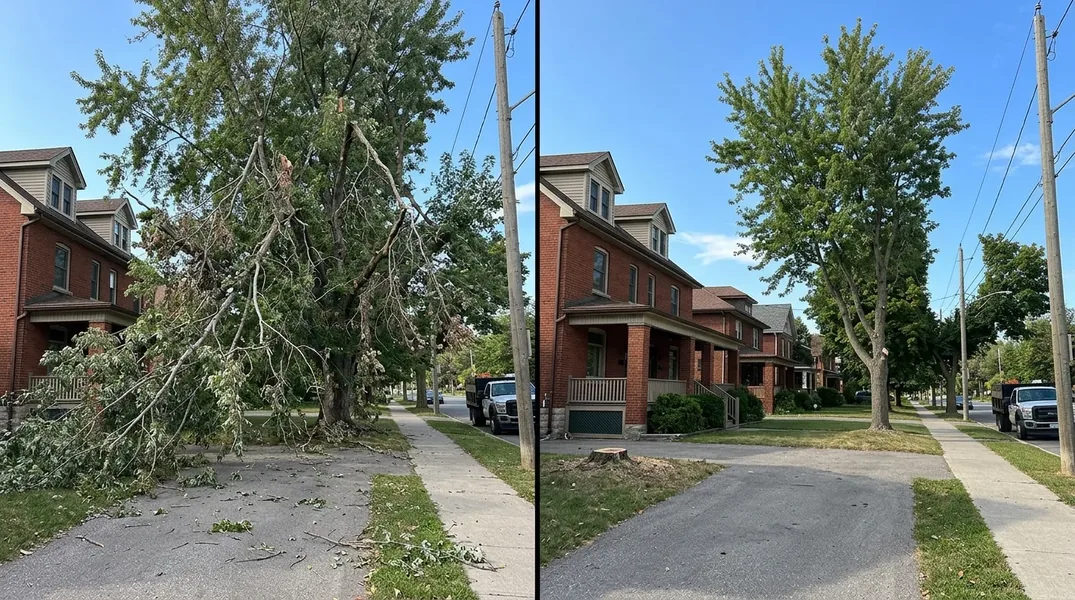
Lean is another critical sign. A mature maple that has developed a noticeable tilt, especially if it has shifted recently or leans toward your house, may be at risk of failure. Similarly, if major limbs are cracked, split, or hanging at odd angles, the tree has already suffered structural damage. Foliage thinning, sparse leaf production in spring, or premature autumn colouration can indicate root problems, disease, or pest pressure. Any combination of these symptoms warrants a professional evaluation before the tree becomes a 24/7 Emergency Tree Removal situation.
Tree Too Close to Your House: When Proximity Demands Action
One of the most common reasons homeowners in Hamilton face the trim-or-remove question is proximity. A mature maple that is too close to your house, garage, deck, or utility lines creates ongoing risk. During storms, high winds, or heavy snow loads, branches can break and fall onto your roof, siding, or windows. Root systems from large trees can eventually affect foundations, underground pipes, or septic systems. If your tree is within 3 to 6 metres of your home, professional guidance is essential.
In many cases, strategic Tree Pruning & Crown Reduction can reduce the risk by removing dead wood, thinning the crown to reduce wind resistance, and cutting back branches that overhang your structure. This approach preserves the tree while lowering the danger. However, if the tree is severely diseased, has a poor structure, or is leaning towards your home, removal may be the safer and more cost-effective choice in the long run. Escarpment Tree Trimming can assess your specific situation and recommend the best path forward. Contact us at (289) 796-3100 for a free estimate.
Cost Comparison: Tree Trimming vs. Removal
Understanding the financial side of the decision is important for most homeowners. The cost to trim a mature maple is generally lower than removal, ranging from a few hundred to a couple of thousand dollars depending on the tree's size, condition, and access. Routine pruning and crown reduction maintain the tree's health and appearance while extending its lifespan. However, if trimming is done repeatedly on a declining tree, costs accumulate over time without addressing the underlying problem.
The cost to remove a tree in Hamilton varies based on height, diameter, proximity to structures, and site conditions. Removal typically costs more upfront, sometimes $1,500 to $5,000 or more for a large mature maple, but it is a one-time expense. Stump grinding adds to the cost but eliminates the risk of regrowth and reclaims usable yard space. If you are facing repeated repairs, storm damage, or ongoing health decline, removal can be the more economical long-term choice. For a detailed quote tailored to your tree and property, call Escarpment Tree Trimming at (289) 796-3100 or request a free estimate online.
Dead Tree Removal and Health Decline
A dead or dying maple must be removed. Tree Removal of dead trees is not optional; it is a safety imperative. Dead wood becomes brittle and unpredictable. Branches can fail without warning, especially during wind or snow events. A completely dead tree can topple entirely, causing catastrophic damage to your home or injuring someone on your property. Insurance may not cover damage from a dead tree that the homeowner knew about but failed to address.
The challenge is that trees do not always die all at once. A maple may be partially dead, with some branches and sections still living while others have failed. This is where a professional tree assessment becomes invaluable. An arborist can determine whether the tree has enough viable wood and vigour to recover with pruning, or whether it has crossed the point of no return. If the assessment confirms significant decline or death, prompt removal prevents liability and opens the door to replanting or redesigning that area of your landscape. Escarpment Tree Trimming provides expert tree assessment and removal services throughout the Hamilton area.
Getting a Professional Arborist Opinion in Hamilton
The single best decision you can make is to have a certified arborist evaluate your tree before you commit to any action. A professional tree assessment is an investment that often pays for itself by preventing costly mistakes. An ISA Certified Arborist will inspect the tree's structure, health, and risk factors, then provide a clear recommendation and explanation. They can also advise on pruning techniques that preserve the tree's longevity, or confirm that removal is the right choice.
Escarpment Tree Trimming brings professional expertise and local knowledge to every assessment. Our team understands the soil conditions, climate challenges, and common pests affecting maples in the Hamilton area. We document our findings in a detailed report that you can use for insurance purposes, permit applications, or simply to make an informed decision. Whether your tree needs trimming, crown reduction, or removal, we will help you understand your options and the reasons behind our recommendation. Call (289) 796-3100 today to schedule your free estimate and tree assessment.
Looking for a professional in Hamilton? Escarpment Tree Trimming responds quickly for all your tree trimming needs.
Get a free estimateOur services : Tree Removal · Tree Trimming · Tree Pruning & Crown Reduction